
The Ultimate 2026–2027 Guide to Manta Rays in the Maldives
Your complete resource for season forecasts, top sites, ethical snorkeling, and conservation


July, 2026
There are few moments in the natural world that leave you breathless — and swimming alongside a manta ray is one of them. With wingspans stretching up to 15 feet and the largest brain-to-size ratio of any cold-blooded fish, these gentle giants possess cognitive abilities on par with dolphins, primates, and elephants. They glide through the water with a grace that seems almost otherworldly.
The Maldives offers what many consider the world's most reliable and spectacular manta ray encounters. The Baa Atoll UNESCO Biosphere Reserve, home to the largest-known manta population on Earth, draws thousands of visitors each year. And with the 2025 season recording an estimated 4,265 reef manta sightings — along with 28 whale sharks, 16 devil rays, and 10 oceanic mantas — the 2026–2027 season promises to be equally extraordinary.
This comprehensive guide covers everything you need to know: the 2026–2027 season forecast, Hanifaru Bay rules, the best sites beyond the bay, how to identify different manta species, ethical snorkeling practices, and how you can contribute to conservation through citizen science.


2026–2027 Manta Season Forecast – When and Where to Go
Understanding the Monsoon Patterns
The Maldives experiences two distinct monsoon seasons, each influencing where manta rays congregate:
| Monsoon | Months | Key Region | Sighting Probability |
|---|---|---|---|
| Southwest (Hulhangu) | June–November | Baa Atoll (Hanifaru Bay) | Very High – peak feeding aggregations |
| Northeast (Iruvai) | December–May | Raa Atoll | High – cleaning station activity |
During the southwest monsoon, plankton-rich waters are pushed into Hanifaru Bay on rising tides, creating spectacular feeding events. During the northeast monsoon, manta rays migrate north to Raa Atoll, where multiple cleaning stations attract large numbers.
The "Hot Dates" — 2026–2027 Prime Viewing Periods
Drawing on two decades of meticulous research, the resident Manta Trust experts at Four Seasons Resort Maldives at Landaa Giraavaru have revealed the prime manta encounter dates for 2026 and 2027. These "hot dates" are peak periods when mass aggregations are most likely to occur.
2026 Hot Dates:
-
May 14–18
-
May 29 – June 2
-
June 13–17
-
June 27 – July 1
-
July 12–16
-
July 27–31
-
August 10–14
-
August 26–30
-
September 9–13
-
September 24–28
-
October 8–12
-
October 24–28
-
November 7–11
-
November 24
2027 Hot Dates:
-
May 4–8
-
May 18–22
-
June 2–6
-
June 16–20
-
July 2–6
-
July 16–20
-
July 31 – August 4
-
August 15–19
-
September 28 – October 2
-
October 13–17
-
October 27–31
-
November 12–16
-
November 26–30
Pro Tip: Book your trip around these dates for the statistically highest chance of witnessing mass manta aggregations. Many resorts require advance booking for Hanifaru Bay slots, especially during peak periods.
Hanifaru Bay – The Crown Jewel of Manta Encounters
Location and Significance
Hanifaru Bay is a small, enclosed bay located on the uninhabited island of Hanifaru within the Baa Atoll UNESCO Biosphere Reserve. It is the most famous marine site in the Maldives — and the only one where scuba diving is formally prohibited.
When the southwest monsoon drives plankton into the bay on a rising tide with the right lunar phase, up to 200 reef manta rays gather to filter-feed in a frenzy that can last for hours. This is one of the largest documented feeding aggregations of manta rays anywhere in the world.
Key Rules and Regulations
Hanifaru Bay is strictly protected and managed. Here's what you need to know:
| Rule | Detail |
|---|---|
| Snorkel-only | Scuba diving is strictly prohibited to protect the fragile ecosystem |
| In-water time limit | Each session is limited to 45 minutes |
| Group size | Maximum of 10 snorkelers per guide |
| Simultaneous visitors | Only 20 visitors at a time in the bay |
| Boats | No more than 8 boats at any time |
| Distance rule | Keep at least 3 metres from manta rays and whale sharks |
| Permits required | Access only through licensed tour operators and Biosphere Reserve-compliant resorts |
Costs and Access
-
Entry fee: Approximately USD 30–50 per person for bay access
-
Guided tour: USD 50–150 depending on operator
-
Resort excursions: Typically USD 250 per person for a full Hanifaru Bay snorkeling trip
-
Conservation contribution: Some resorts, including Four Seasons, donate USD 5 to the Hanifaru Bay NGO fund on behalf of each guest entering the bay
Important: You cannot simply arrive at Hanifaru Bay independently. Book through your resort or liveaboard operator well in advance.
Best Time for Hanifaru Bay
The peak season for Hanifaru Bay runs from June to November, with especially strong manta possibilities around new moon and full moon. The absolute peak is from late July to October, when dozens to over 100 manta rays can be seen feeding in the bay.
The Science Behind the Spectacle – Why 200+ Mantas Gather Here
The Plankton Phenomenon
Hanifaru Bay's unique geography creates a natural plankton trap. During the southwest monsoon, nutrient-rich waters are pushed into the narrow, funnel-shaped bay on rising tides. The bay's shape concentrates the plankton, creating a "buffet" that attracts reef mantas in staggering numbers.
Filter-Feeding in Action
Manta rays are filter feeders. They swim with their mouths wide open, filtering plankton from the water through specialized gill rakers. A single manta can filter up to 100 litres of water per minute during feeding events. When conditions are perfect, the bay becomes a swirling ballet of dozens — sometimes hundreds — of mantas performing synchronized barrel rolls as they feed.
The Role of Moon Phases
Tidal movements are amplified during new moon and full moon periods, creating stronger currents that push more plankton into the bay. This is why the "hot dates" released by the Manta Trust align closely with these lunar cycles.
Top 5 Manta Ray Sites Beyond Hanifaru Bay
While Hanifaru Bay steals the spotlight, the Maldives offers many other world-class manta encounter sites — often with fewer crowds.
1. Manta Point (South Malé Atoll)
Located near Lankanfinolhu Island, Manta Point is a gently sloping reef featuring three cleaning stations where mantas queue up to have parasites removed by cleaner wrasse. The site features a gently sloping reef where mantas gather from June to November.
-
Depth: 10–18 metres
-
Experience level: Suitable for all levels
-
Best season: June–November
2. Fushifaru Thila (Lhaviyani Atoll)
Fushifaru Thila is a stunning underwater pinnacle famous for its cleaning stations. The site offers excellent visibility and frequent manta encounters.
-
Depth: 12–25 metres
-
Experience level: Intermediate (currents possible)
-
Best season: Year-round, with peaks in the northeast monsoon
3. Kandholhudhoo / Kottefaru Bodu Thila (Raa Atoll)
Raa Atoll is the insider's choice — a less-visited area that sits along an emerging manta migration corridor. Kottefaru Bodu Thila's reef top becomes a manta ray cleaning station from roughly June to November, with peak activity from July to November.
-
Depth: 12–16 metres
-
Experience level: Intermediate drift dive
-
Best season: June–November (cleaning station activity)
4. Rasdhoo Madivaru (Rasdhoo Atoll)
Rasdhoo Madivaru offers regular manta sightings with excellent coral cover and clear water.
-
Depth: 15–25 metres
-
Experience level: Intermediate
-
Best season: Year-round
5. Anga Faru (Baa Atoll)
Located close to Hanifaru Bay, Anga Faru offers scuba diving opportunities with frequent manta encounters — a great alternative if you want to dive rather than snorkel.
-
Depth: 15–30 metres
-
Experience level: Intermediate to advanced
-
Best season: June–November
Comparison Table: Top Sites at a Glance
| Site | Atoll | Best Season | Depth | Activity Type |
|---|---|---|---|---|
| Manta Point | South Malé | Jun–Nov | 10–18m | Snorkel / Dive |
| Fushifaru Thila | Lhaviyani | Year-round | 12–25m | Dive |
| Kottefaru Bodu Thila | Raa | Jul–Nov | 12–16m | Dive |
| Rasdhoo Madivaru | Rasdhoo | Year-round | 15–25m | Dive |
| Anga Faru | Baa | Jun–Nov | 15–30m | Dive |
Reef Manta vs. Oceanic Manta – How to Spot the Difference
Two Species, One Destination
The Maldives is home to two species of manta rays. In 2009, scientists formally established the reef manta (Mobula alfredi) and the giant oceanic manta (Mobula birostris) as distinct species.
| Feature | Reef Manta (Mobula alfredi) | Oceanic Manta (Mobula birostris) |
|---|---|---|
| Size (wingspan) | 3–4.5 metres (up to 5.5m) | 4–7 metres |
| Weight | Up to 700 kg | Up to 1,600+ kg |
| Dorsal pattern | V-shaped shoulder markings | T-shaped shoulder markings |
| Ventral spots | Throughout underside (wings + belly) | Mostly restricted to belly |
| Habitat | Shallow coastal waters, coral reefs | Deep open ocean, migratory |
| Frequency in Maldives | Very common — resident population | Less common — seasonal visitation |
Which Will You See?
The reef manta ray is the species most commonly seen in the Maldives. The Maldives also supports a seasonal migration of oceanic mantas, typically from March to May in the southern atolls.
Individual Identification — The Belly Spot "Fingerprint"
Each manta ray carries a unique belly-spot pattern — like a fingerprint. This is how the Maldives' long-running identification database has tracked thousands of named animals. The Maldives Manta Conservation Programme has identified over 6,000 different individual reef manta rays from more than 80,000 photo-ID sightings.
How to Snorkel Responsibly – The 2026 Code of Conduct
Why Ethics Matter
Research has shown that tourist behaviour can affect reef manta ray feeding behaviour. The Manta Trust has developed a Best Practice Code of Conduct for Manta Ray Tourism based on quantifiable research. Following these guidelines enhances your experience while ensuring your presence does not disturb the mantas.
The Manta Trust 10-Step Code of Conduct
-
Enter quietly — Enter the water calmly, no closer than 10 metres from the manta ray
-
Keep fins submerged — Avoid splashing; loud noise causes avoidance behaviour
-
Maintain distance — Never approach closer than 3 metres
-
Never touch — Touching mantas removes their protective mucus layer
-
Don't chase or block — Let the manta come to you; never block its path
-
No flash photography — Flash can stress and disorient the animals
-
Observe passively — Slow, controlled movements are less likely to spook the shark
-
Follow your guide — Certified guides know the animals and conditions best
-
Respect time limits — 45-minute maximum in Hanifaru Bay
-
Choose responsible operators — Book only with operators following the Manta Trust guidelines
How to Identify a Responsible Operator
-
Ask if they follow the Manta Trust Code of Conduct
-
Check if they employ certified guides with proper training
-
Confirm they respect capacity limits and don't overcrowd sites
-
Look for operators that contribute to conservation efforts (e.g., MMCP donations)
Citizen Science – How You Can Help Protect Maldives Mantas
The Maldives Manta Conservation Programme (MMCP)
Formed in 2005, the Maldives Manta Conservation Programme (MMCP) is a Maldives-registered NGO and the Manta Trust's founding research project. After two decades of research, the MMCP has evolved into one of the largest and longest-standing manta ray conservation groups in the world.
The MMCP consists of a country-wide network of researchers, educators, dive instructors, biologists, communities, and tourism operators. In the 2025 season alone, the Manta Trust conducted 1,282 manta surveys over 143 research days.
How You Can Contribute
Photo Identification
Each manta has a unique belly-spot pattern. By submitting clear photographs of the ventral (belly) side of any manta you encounter, you can help scientists track individual movements, population sizes, and migration patterns.
-
Submit your photos through the IDtheManta platform
-
Over 80,000 photo-ID sightings have been submitted by members of the public
-
Your photo could help identify a new individual — or re-sight a known manta
Choose Conservation-Focused Operators
-
Book with operators that contribute to MMCP research
-
Support resorts with marine biology programmes (e.g., Soneva Fushi, Four Seasons)
-
Participate in citizen-science research cruises
Spread Awareness
-
Share your experiences responsibly on social media
-
Educate others about the Manta Trust Code of Conduct
-
Support marine conservation organisations working in the Maldives
Conservation Milestones
Through the Manta Trust's dedicated work, all 10 manta and devil ray species have been uplisted to CITES Appendix I — meaning they have the highest level of international protection. International commercial trade of these species is now prohibited, helping to safeguard their future.
Mantas & Whale Shark Photography Guide"Since 2005, the Maldives Manta Conservation Programme at Landaa Giraavaru has been dedicated to protecting these remarkable creatures, and every snorkel, survey or moment spent alongside them helps build a community committed to their survival." — Armando Kraenzlin, Regional Vice President and General Manager, Four Seasons Resort Maldives at Landaa Giraavaru
Frequently Asked Questions
When is the best time to see manta rays in the Maldives?
It depends on the atoll. For Hanifaru Bay, the peak is during the southwest monsoon from June to November. For Raa Atoll, the best months are December to May during the northeast monsoon. Overall, the Maldives offers year-round manta encounters with proper planning.
Can I scuba dive with manta rays in Hanifaru Bay?
No. Scuba diving is strictly prohibited in Hanifaru Bay to protect the fragile plankton ecosystem. Only snorkeling is permitted, and all visitors must be accompanied by certified guides under strict capacity limits.
How many manta rays can I see at Hanifaru Bay at once?
During peak feeding events, Hanifaru Bay can host between 50 and 250 manta rays simultaneously — one of the largest documented feeding aggregations in the world.
How much does it cost to visit Hanifaru Bay?
-
Entry fee: Approximately USD 30–50 per person
-
Guided tour: USD 50–150 depending on operator
-
Resort excursions: Typically USD 250 per person
-
Conservation contribution: Some resorts donate USD 5 per guest to the Hanifaru Bay NGO fund
How can I contribute to manta ray conservation in the Maldives?
You can submit your manta ray belly photos to the Maldives Manta Conservation Programme (MMCP) through the IDtheManta platform. Choose tour operators that follow the Manta Trust Code of Conduct and contribute to conservation. Support resorts with strong marine biology programmes.
What is the difference between a reef manta and an oceanic manta?
Reef mantas (Mobula alfredi) are smaller (3–4.5m wingspan), have V-shaped shoulder markings, and are resident in shallow coastal waters. Oceanic mantas (Mobula birostris) are larger (4–7m wingspan), have T-shaped shoulder markings, migrate through deeper waters, and are sighted less frequently in the Maldives.
Is it guaranteed to see manta rays?
While no sighting is ever 100% guaranteed, the Maldives offers one of the highest success rates in the world. The 2025 season recorded approximately 4,265 reef manta sightings, and the Baa Atoll is home to the largest-known manta population. Following the "hot dates" forecast significantly increases your chances.
Final Thoughts
Swimming with manta rays in the Maldives is one of those rare experiences that genuinely deserves the label "once-in-a-lifetime." The combination of the largest-known manta population, the spectacular feeding aggregations of Hanifaru Bay, and the warmth of Maldivian hospitality creates something truly magical.
The 2026–2027 season brings more opportunities than ever — and more responsibility. With the CITES Appendix I uplisting of all manta and devil ray species, the new Hanifaru Bay regulations, and the ongoing work of the Maldives Manta Conservation Programme, we all have a role to play in protecting these gentle giants for future generations.
Whether you choose to snorkel in the plankton-rich waters of Hanifaru Bay, dive at a cleaning station in Raa Atoll, or contribute your photographs to citizen science, your encounter can be more than just a holiday memory — it can be a meaningful contribution to manta ray conservation.
Plan ahead. Choose responsible operators. Respect the code of conduct. And prepare for an encounter you'll never forget.
Related Stories:

2025 Maldives Resort Trends: What’s New for Multi-Generational Travel?
New Openings & Multi-Generational Family Travel Guide
Read More
Best Maldives Resort Offers & Packages
Find out more about the most unparalleled Maldives hotel deals and special rates, when Book Direct your next beach holiday
Read More
Maldives Hotel Reviews
Some of the best hotels and resorts in the Maldives are already included in this list, and the good part of them offers the best prices. We will constantly add new hotels
Read More
Maldives First Time Visitor Guide: Essential Tips & Insight
Welcome to our comprehensive guide for first-time visitors to the Maldives!
Read More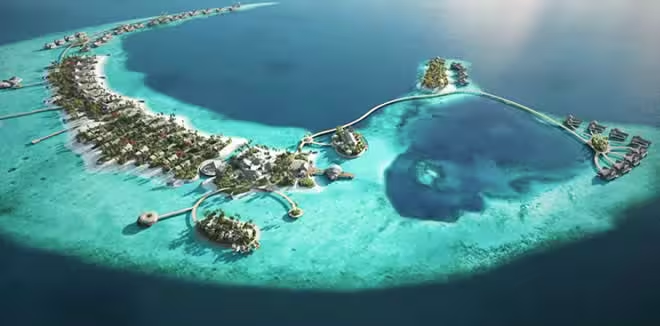
The Most Anticipated Openings in the Maldives 2025/26
Dive in to explore what makes these luxury Maldives openings 2025/26 so special
Read More
Maldives Liveaboards Guide: Itineraries, Tips & Best Boats
Plan your Maldives liveaboard trip with our expert guide! Compare itineraries, costs, and boats.
Read More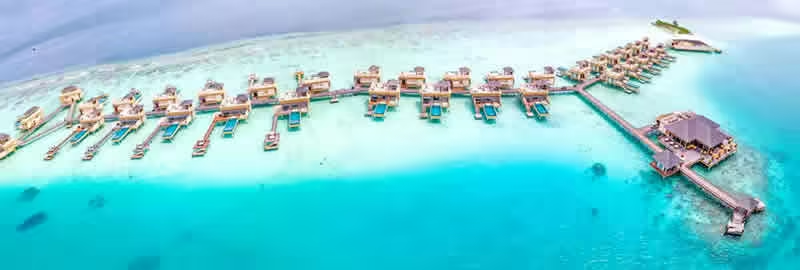
Maldives Luxury Guide
Here's the best of Maldives for luxury travellers. We've compiled the finest recommendations of places to stay, ranging from the most celebrated five-star resorts to luxurious private islands Read More

Maldives Romantic Guide
The ultimate ‘flop and drop' and honeymoon destination, the Maldives is the playground for the most amazing and finest utilization of each second of this extremely valuable and hopeful time with each other in tota Read More

Maldives Budget Guide
Budget travellers choose Maldives as their destination of choice thanks to the variety of affordable stays Read More

Maldives Family Guide
Maldives - a name that became synonymous with honeymooners' paradise in the tourism world, has slowly Read More

Maldives Diving Guide
The life of these paradise islands below the Indian Ocean's level is the main draw attracting thousands of divers Read More